
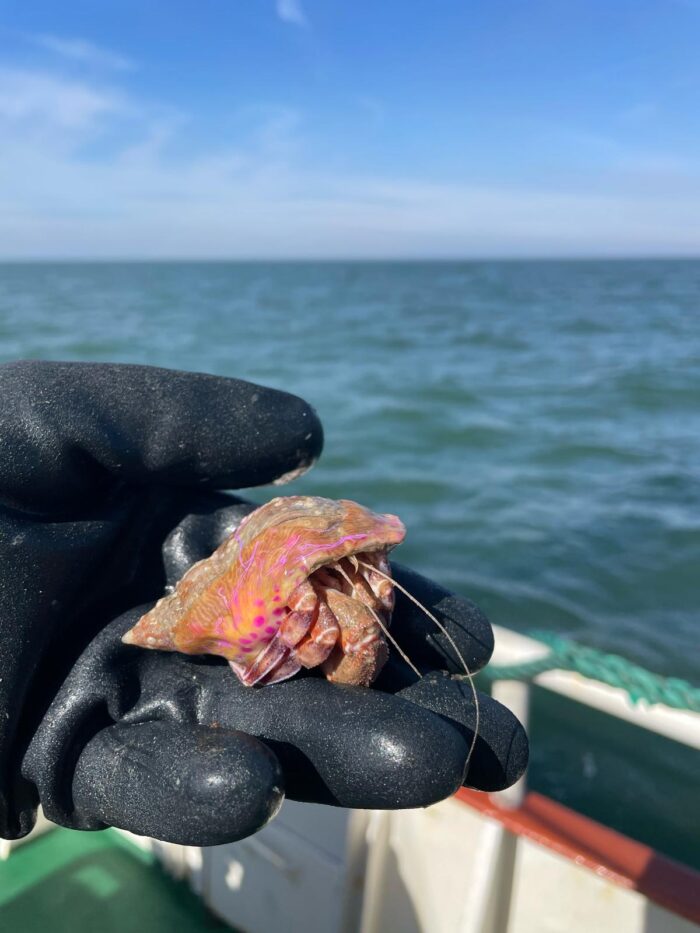
Hermit crabs are decapod crustaceans belonging to the superfamily Paguroidea, with over 800 known species. Unlike many other crustaceans, most hermit crabs have soft, unprotected abdomens that lack a hardened exoskeleton. To compensate, they inhabit hollow objects—most commonly empty gastropod shells—which offer protection from predators and temperature fluctuations. These shells, which the hermit crabs carry with them, function as mobile shelters and have often been described as “portable burrows.”
Most hermit crabs have a curved abdomen, which allows them to fit securely into spiral shells and use their abdominal muscles to grip the interior. They also typically have asymmetrical claws, with the larger claw used to block the shell’s entrance for protection. However, there are exceptions. Pagurus prideaux, a species found in Northwest Europe, has a more symmetrical body plan and relies on a different strategy—partnering with a sea anemone attached to its shell to help conceal the entrance and deter predators.
As the crab grows, they need shells of increasing size. Decision making behaviour is therefore a crucial element of hermit crab ecology, providing a critical subject for crustacean research. When a crab outgrows their current shell and seeks a new home, they must find a new shell that optimises the relationship between crab and shell size. However, more suitable shells are usually already occupied by another hermit crab, causing a crab to fight against the current occupier. The attacker will first knock on the shell of the current resident before instigating a fight of usually eight to ten rounds, with a successful encounter ending with the exchange of shells.
The continuous repurposing of discarded shells causes them to be recirculated amongst an ecosystem, rather than being buried in sediment. For this reason, hermit crabs provide a wider service to the local environment and can be described as ‘allogenic engineers’ – organisms that modify their environment by altering physical resources.
There are 15 species of hermit crab in the UK, distributed across the shoreline, with the most widespread being the common hermit crab (Pagurus bernhardus). Whilst populations of hermit crabs are currently stable in the UK, multiple threats have been identified, which may influence populations soon. Pollution has seen growing awareness as hermit crabs continue to utilise plastic debris instead of gastropod shells as homes. Increased levels of plastic, eutrophication, and heavy metal pollution have all been shown to impair their decision making, thus influencing predation levels. Protecting hermit crab habitats and reducing marine pollution will be essential to ensuring the continued stability of these unique and ecologically important crustaceans.
Written by: Amy Fisher
References:
Briffa, M. and Mowles, S.L. (2008). Hermit crabs. Current Biology, 18(4): R144–R146.
Williams, J.D. and McDermott, J.J. (2004). Hermit Crab biocoenoses: a Worldwide Review of the Diversity and Natural History of Hermit Crab Associates. Journal of Experimental Marine Biology and Ecology, 305(1): 1–128.