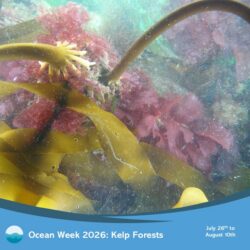
Whilst conducting drop down video (DDV) and intertidal surveys across the UK, Eco marine has observed and identified the kelp forest habitats. Kelp species vary across bioregions, with UK kelp forests classified by the large seaweeds dabberlocks Alaria esculenta, oarweed Laminaria digitata, Tangle or Cuvie Laminaria hyperborea and sugar kelp Saccharina latissima, which all occur in temperate coastlines. Located from the low tide line down to depths of 45m, air bladders contained within the fronds keep the kelp stalk upright, creating the underwater forest effect. If the kelp forms a canopy on the surface, then the habitat is a kelp forest. If there is no canopy, then the habitat is referred to as a kelp bed!
Through the direct provisioning of structural habitats, kelp forests are “ecosystem engineers” that can alter light levels, water flow, and sedimentation rates of the local environment. These structural habitats promote increased biodiversity and biomass of fish and invertebrate species, including invertebrate species such as polychaetes, shrimps Palemon spp., cuttlefish Sepiola atlantica, and common brittle stars Ophiothrix fragilis. Economically important fish species such as pollack Pollachius pollachius and Atlantic cod Gadus morhua utilise the habitat as nursery grounds, whilst marine mammals such as grey seals Halichoerus grypus also use the habitat for protection.
The influence of kelp forests is not limited to the marine world. The habitat is vital for reducing physical disturbance on land, providing a buffer against storm surges by reducing wave energy and so reducing coastal erosion of nearby shores. Additionally, kelp forests have shown to be hugely influential in the capture and export of carbon. Compared to other carbon sink habitats such as mangrove and seagrass which sequester carbon into soft, fine substrates, kelp forests have been found to sequester carbon into the deep ocean, beyond the ocean surface mixing layer. The broad reach social and economic impacts of kelp forests carbon sequestration is only recently being discovered in the literature.
In the UK, kelp forests and beds are widespread and are estimated to occur across 60% of the coastline where there is rocky substrate. Large forests are known to occur in north Scotland, southwest Wales and southwest England, with distribution largely dependent on the light levels due to the critical function of photosynthesis. Additionally, it has been shown that areas with slightly higher turbulence increase productivity of kelp forests by promoting nutrient transfer and reducing intraspecific competition for light.
A recent Red List for British seaweeds reported that 7% of the 617 seaweed species found in the UK are threatened. This includes A. esculenta being classified as ‘endangered’, L. digitata as ‘vulnerable’, and L. hyperborea as ‘near threatened’. As kelps are cool-water species that are stressed by high temperatures, their distribution, structure, and productivity will largely be influenced by changes in water temperatures linked to climate change. Wider implications for the habitat may then be expected, with significant changes in weather buffering and carbon storing processes likely to occur.
Eco Marine has a range of capabilities to survey this habitat. To discuss your project’s survey needs, please do get in touch.
References:
Bayley, D., Brickle, P., Brewin, P., Golding, N., and Pelembe, T. (2021). Valuation of Kelp Forest Ecosystem Services in the Falkland Islands: a Case Study Integrating Blue Carbon Sequestration Potential. One Ecosystem, 6. https://doi.org/10.3897/oneeco.6.e62811
Earp, H. S., Delany, J., and Sugden, H. (2026). The Structure of Intertidal Kelp Forests and Their Associated Assemblages along the north-east Coast of the United Kingdom. Biodiversity and Conservation, 35(3). https://doi.org/10.1007/s10531-026-03302-2
Pedersen, M., Nejrup, L., Fredriksen, S., Christie, H., and Norderhaug, K. (2012). Effects of Wave Exposure on Population structure, demography, Biomass and Productivity of the Kelp Laminaria Hyperborea. Marine Ecology Progress Series, 451, 45–60. https://doi.org/10.3354/meps09594
Schoenrock, K. M., Chan, K. M., O’Callaghan, T., O’Callaghan, R., Golden, A., Krueger‐Hadfield, S. A., and Power, A. M. (2020). A review of subtidal kelp forests in Ireland: From first descriptions to new habitat monitoring techniques. Ecology and Evolution, 10(13), 6819–6832. https://doi.org/10.1002/ece3.6345
Smale, D. A., Burrows, M. T., Moore, P., O’Connor, N., and Hawkins, S. J. (2013). Threats and Knowledge Gaps for Ecosystem Services Provided by Kelp forests: a Northeast Atlantic Perspective. Ecology and Evolution, 3(11), 4016–4038. https://doi.org/10.1002/ece3.774
The Wildlife Trusts. (2020). Kelp Forests. Https://Www.wildlifetrusts.org/Habitats/Marine/Kelp-Forests. https://www.wildlifetrusts.org/habitats/marine/kelp-forests
Written by Amy Fisher